Why Landing Pages Matter
Imagine someone sees your Facebook or Google ad.
The message catches their attention.
They click.
At that point, your advertisement has successfully done its job.
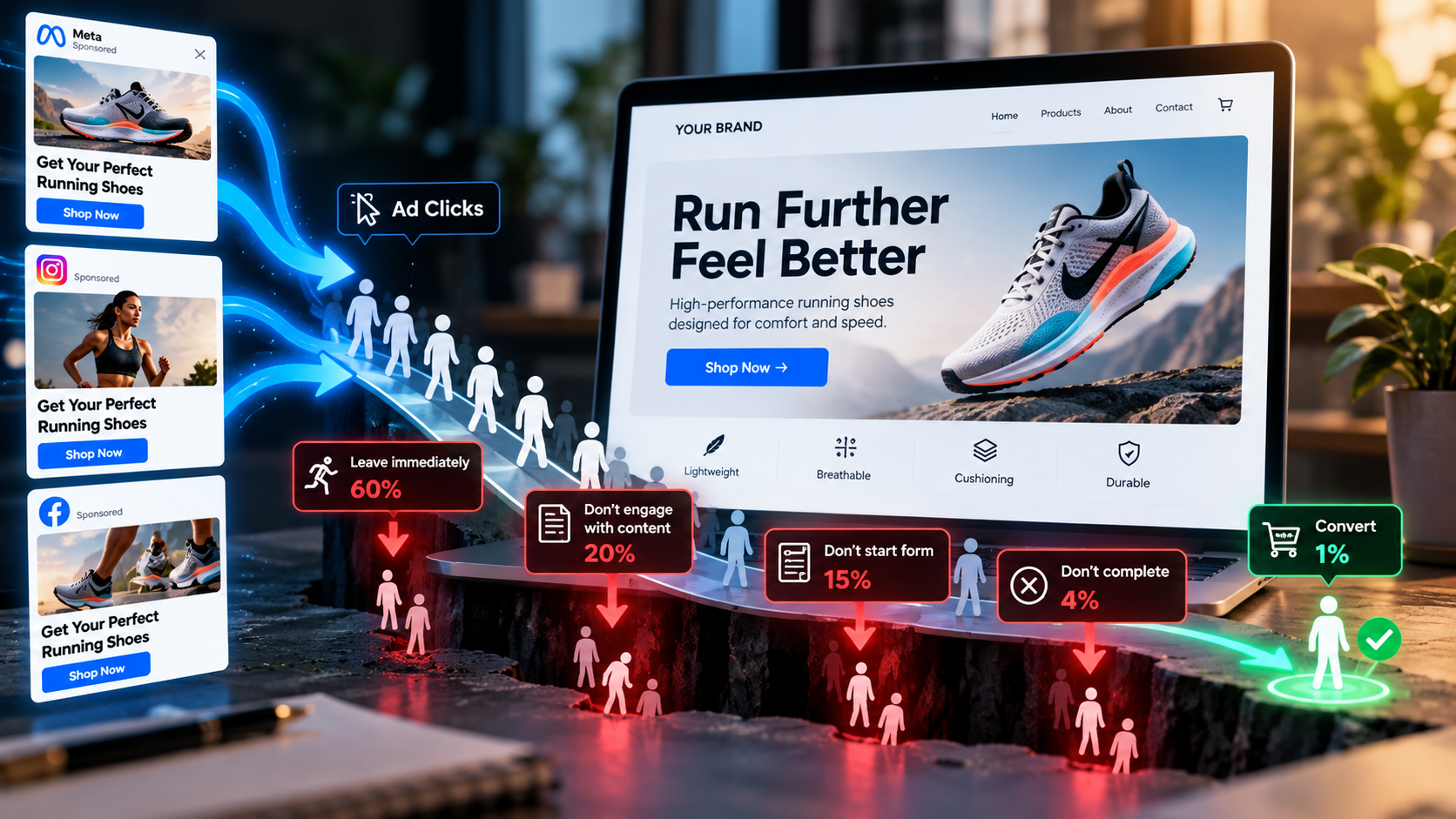
But then the landing page loads.
The headline is confusing. The page has several different buttons. The offer isn't immediately obvious. The visitor has to scroll around to understand what they're supposed to do.
A few seconds later, they're gone.
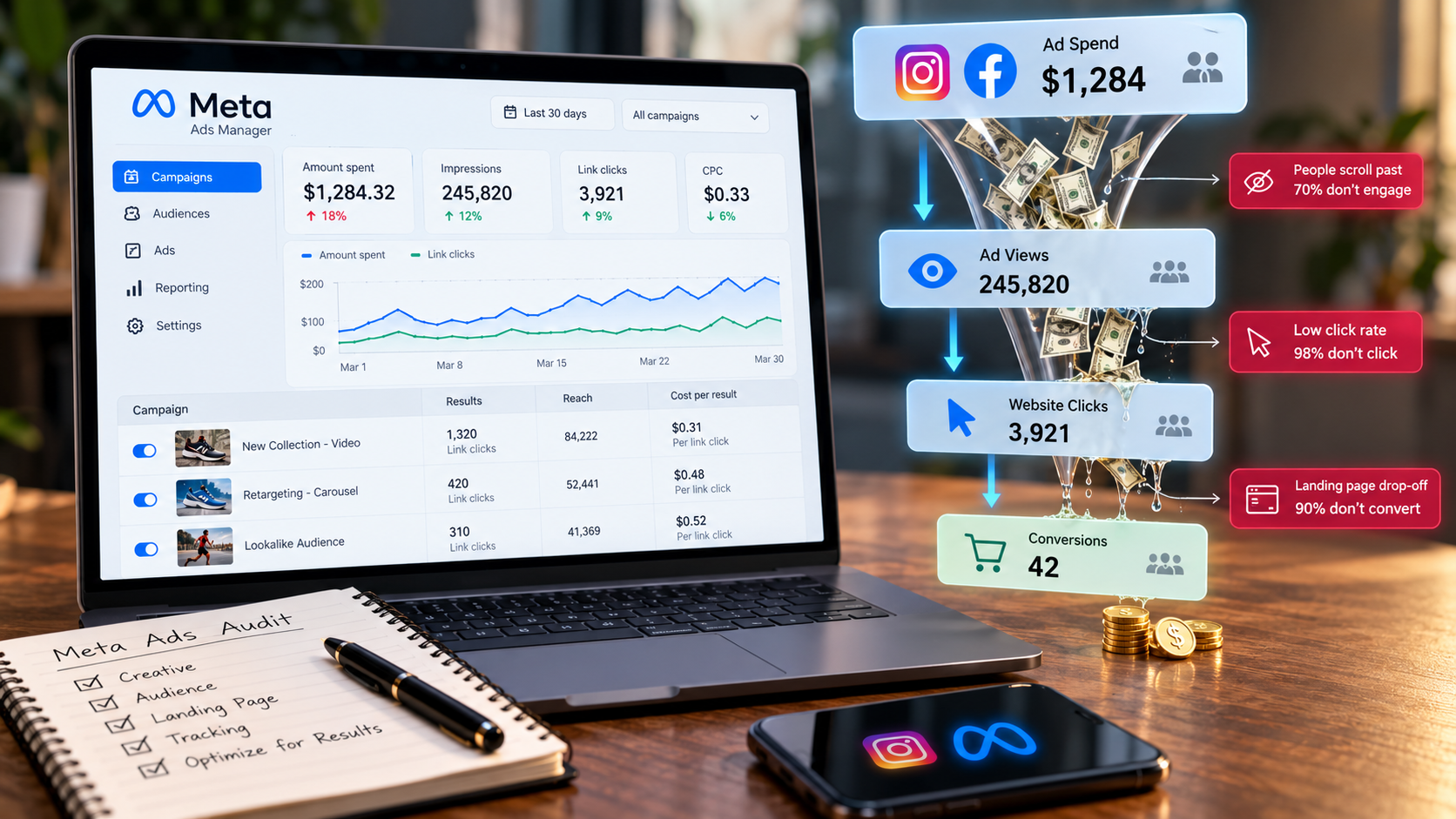
This is why more traffic doesn't always mean more conversions.
Your advertising gets people through the door.
Your landing page needs to convince them to take the next step.
Here are seven problems I would look for when a page is receiving traffic but isn't generating enough leads or sales.
1. Your Headline Doesn't Match Your Ad
Your landing page should feel like a continuation of the advertisement that brought someone there.
Suppose your ad says:
"Get a Free Digital Marketing Audit"
Someone clicks because they want a free audit.
But the landing page headline says:
"Grow Your Business With Our Marketing Services"
The topic is related, but the promise has changed.
That creates unnecessary friction.
Instead, maintain message consistency between your ad and landing page.
Ad
Get Your Free Digital Marketing Audit
Landing Page
Get Your Free Digital Marketing Audit
Simple.
The visitor immediately knows they're in the right place.
2. Your Value Proposition Isn't Clear
Visitors shouldn't have to investigate your website to understand what you're offering.
Within the first section of your landing page, they should be able to understand:
What is this?
Who is it for?
Why should I care?
What should I do next?
Compare these two headlines:
"Solutions Designed for Modern Businesses"
versus:
"Get a Free Meta Ads Audit and Find Where Your Ad Budget Is Being Wasted"
The second version communicates much more information.
Specificity helps people make decisions.
Your landing page isn't the place to make visitors solve a puzzle.
3. You Have Too Many Calls-to-Action
More choices don't always create more conversions.
Imagine reaching a landing page and seeing:
Contact Us
Download Our Guide
Follow Us on Instagram
Read Our Blog
View Our Services
Subscribe
Book a Call
Where should you go?
A focused landing page should generally have one primary conversion goal.
For example:
Book a Free Consultation
You can repeat that CTA throughout the page without introducing several competing actions.
The goal is to make the next step obvious.
4. Your Page Doesn't Build Trust
You're asking someone who may have discovered your business 30 seconds ago to give you something.
That could be their:
- Email address
- Phone number
- Credit card
- Time
- Personal information
They need a reason to trust you.
Depending on your business, trust signals might include:
Customer testimonials
Case studies
Client logos
Specific results
Professional credentials
Clear contact information
Examples of previous work
For a service business, a case study can be particularly valuable because it shows visitors how you approach real problems.
Don't just tell people you're experienced.
Show evidence.
5. You're Asking for Too Much Information
Every additional form field creates another decision for the visitor.
If you're offering a free 15-minute consultation, do you really need someone's:
- First name
- Last name
- Company
- Job title
- Address
- Phone number
- Revenue
- Employee count
- Marketing budget
- Favorite breakfast cereal
Probably not.
Ask for the information you actually need to take the next step.
You can collect additional information later when it's relevant.
Reducing unnecessary friction can make the conversion process feel easier.
6. You're Ignoring Mobile Visitors
A landing page that looks beautiful on a desktop can be frustrating on a phone.
Check your page on an actual mobile device.
Look for:
Text
Is it easy to read without zooming?
Buttons
Are they large enough to tap?
Forms
Are they simple to complete?
Images
Are they loading correctly?
Navigation
Is anything overlapping or getting cut off?
Page Speed
Does the page feel slow?
Don't assume your desktop design automatically translates into a good mobile experience.
Your visitor only experiences the version that's on their screen.
7. You're Driving More Traffic Instead of Fixing the Page
This is where advertising and conversion optimization meet.
Suppose you're spending $1,000 per month on advertising.
You're getting clicks.
But very few visitors convert.
The instinct might be:
"We need more traffic."
So you increase the advertising budget.
But if the landing page is the problem, you've simply paid to send more people into the same broken experience.
Before increasing your budget, look at the funnel:
Ad Impression
↓
Click
↓
Landing Page
↓
Conversion
↓
Customer
Find where people are dropping off.
Then investigate why.
Sometimes improving what happens after the click can be more important than buying additional clicks.
A Simple Landing Page Audit
Before sending more paid traffic to your landing page, ask these questions.
Message
Does the headline match the advertisement that brought the visitor here?
Value
Can someone understand my offer within a few seconds?
CTA
Is there one obvious action I want the visitor to take?
Trust
Have I given the visitor enough evidence to feel comfortable taking that action?
Friction
Am I asking for more information than I actually need?
Mobile
Does the entire experience work properly on a phone?
Measurement
Can I accurately track when someone completes the desired action?
If you answer "no" to several of these questions, I'd work on the landing page before aggressively increasing traffic.
Traffic vs. Conversion: Know What You're Fixing
Here's a simple way to diagnose the problem.
Few people see the offer
→ You may have a traffic or distribution problem.
People see the ad but don't click
→ Investigate your creative, messaging, audience, or offer.
People click but immediately leave
→ Investigate message consistency, page speed, and landing-page experience.
People stay but don't convert
→ Investigate your value proposition, CTA, trust signals, offer, and friction.
People convert but aren't qualified
→ Investigate your targeting, messaging, form qualification, and offer.
This is why digital marketing should be viewed as a connected system rather than a collection of isolated channels.
Final Thoughts
A great advertising campaign can't completely rescue a poor landing page.
Before spending more money to generate traffic, make sure the destination deserves the traffic you're already paying for.
Keep the message consistent.
Make your value clear.
Reduce unnecessary choices.
Build trust.
Remove friction.
And make the next step obvious.
More traffic can increase opportunity. Better conversion helps you capture more of the opportunity you already have.
Getting Traffic but Not Enough Leads?
I help businesses review their digital customer journey—from advertising and creative to landing pages and conversion tracking—to identify where potential customers may be dropping off.
CTA Button: Get a Free Marketing Review
Frequently Asked Questions
What is a landing page?
A landing page is a web page designed around a particular campaign or visitor action, such as generating a lead, booking a consultation, downloading a resource, or purchasing a product.
What is a landing page conversion?
A conversion occurs when a visitor completes the action the landing page is designed to encourage, such as submitting a form, booking an appointment, or making a purchase.
Why am I getting clicks but no conversions?
Possible causes include a mismatch between your ad and landing page, an unclear offer, weak trust signals, unnecessary form friction, poor mobile experience, or tracking issues.
Should I send paid ads to my homepage?
It depends on the campaign, but a focused landing page can give visitors a clearer path toward a specific action than a general homepage containing many different options.
How can I improve my landing page?
Start by reviewing your headline, value proposition, CTA, trust signals, form requirements, mobile experience, and tracking. Make controlled changes and measure what happens rather than changing everything at once.